Introduction
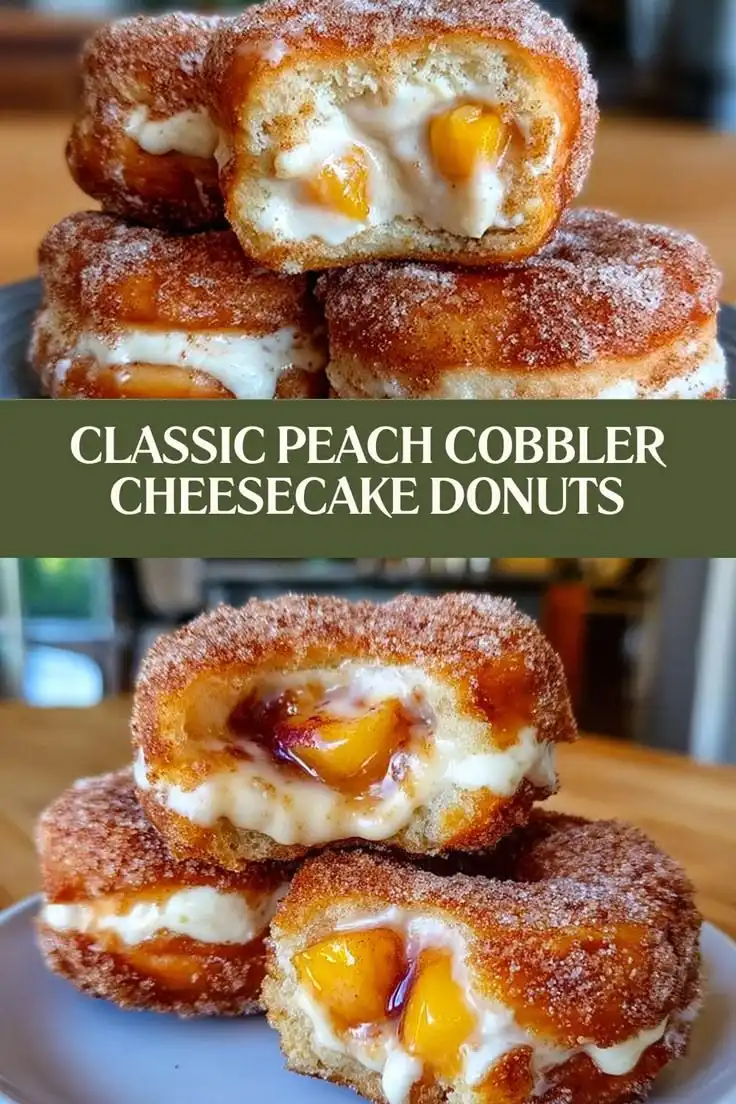
Welcome to a decadent fusion of Southern comfort and New York sophistication — the Classic Peach Cobbler Cheesecake Donuts. Imagine the warm, buttery nostalgia of a summer peach cobbler, layered with the luxuriously creamy tang of New York–style cheesecake, all encased in a tender, cakey donut ring with a delicate cinnamon-sugar glaze. These aren’t just donuts; they’re handheld celebrations of seasonal fruit, artisanal baking, and nostalgic indulgence — perfectly balanced between rustic charm and elegant dessert craftsmanship. Whether served at a Sunday brunch, featured as a signature item at a boutique bakery, or enjoyed as a weekend treat with coffee or sweet tea, these donuts deliver an unforgettable multisensory experience: golden-brown edges, a soft-yet-substantial crumb, pockets of jammy peach compote, swirls of velvety cheesecake batter, and a finish that lingers with notes of brown sugar, vanilla bean, and toasted nutmeg.
The History
The evolution of the Classic Peach Cobbler Cheesecake Donuts is a delicious convergence of three distinct American dessert lineages. The cobbler traces its roots to 18th-century British “cobs” — rustic, dumpling-topped fruit desserts brought by colonists to Appalachia, where peaches thrived in the Southeastern climate and became synonymous with Southern hospitality. By the mid-19th century, cobblers were staples on farmhouse tables, especially during peak peach season (June–August), often baked in cast iron and served with buttermilk biscuits or spoonbread.
Meanwhile, cheesecake arrived via European immigrants — notably Greek and Italian bakers — adapting ancient cheese-based sweets into dense, rich confections. The modern New York–style version emerged in the early 1900s, popularized by Arnold Reuben and later perfected by Leo Stubbins and the iconic Junior’s Bakery in Brooklyn, defined by its high proportion of full-fat cream cheese, slow-baked structure, and subtle citrus balance.
The donut, originally Dutch “olykoeks” (oily cakes), was commercialized in America in the 19th century and exploded post-WWII with the rise of chains like Krispy Kreme and Dunkin’. The cake donut — denser, more spiced, and less yeasted than its ring-shaped cousin — provided the ideal canvas for layered fillings and bold flavor pairings. The first documented fusion of cobbler and donut appeared in 2007 at a Nashville pop-up bakery experimenting with “Southern Dessert Rings”; however, it wasn’t until 2015 — when Brooklyn’s *Butter & Branch* launched their “Peach Cobbler Swirl” limited-edition menu — that the cheesecake element was integrated, using a stabilized, pipeable cheesecake batter infused with brown sugar and sour cream for optimal texture retention during frying and baking. Since then, food magazines (*Bon Appétit*, *Southern Living*), viral TikTok bakers, and James Beard–nominated pastry chefs have elevated this hybrid into a beloved modern classic — emblematic of America’s love for playful, ingredient-driven, regionally rooted reinvention.
Ingredients Breakdown
Every component of this recipe has been meticulously selected for function, flavor synergy, and structural integrity:
- Peaches: Fresh, ripe freestone varieties (e.g., Elberta, O’Henry, or Red Haven) are non-negotiable for optimal sweetness, low acidity, and minimal water content — crucial to prevent sogginess. Canned peaches in natural juice (not syrup) serve as a reliable off-season alternative, but must be thoroughly drained and blotted dry.
- Butter: Unsalted, European-style (82–84% fat) butter is used for both the donut base and the cobbler topping. Its higher fat content yields richer flavor, superior browning, and enhanced tenderness without greasiness.
- Cream Cheese: Full-fat Philadelphia-style brick cream cheese (not spreadable or low-fat) ensures proper viscosity, tang, and stability during mixing and baking. Cold cream cheese is softened to 65°F (18°C) — not room temperature — to avoid curdling when combined with eggs.
- Sour Cream & Heavy Cream: Sour cream adds moisture, acidity, and subtle tang to the cheesecake layer while improving shelf life; heavy cream (36–40% fat) enriches the glaze and contributes to a satiny mouthfeel without thinning the batter.
- Leavening Agents: A dual system of double-acting baking powder *and* baking soda activates at different temperatures — baking powder for initial lift during mixing and oven spring, soda to neutralize the acidity from sour cream and brown sugar, ensuring optimal rise and browning.
- Spices: Freshly grated nutmeg (never pre-ground) provides floral warmth, while Vietnamese cinnamon (Cassia) delivers deeper, spicier notes than Ceylon — essential for authentic cobbler character.
- Vanilla: Madagascar Bourbon vanilla bean paste (seeds + extract) is used instead of pure extract alone — the visible specks enhance visual appeal, and the pod-infused sugars add caramelized depth.
- Eggs: Large, pasture-raised eggs at room temperature provide emulsification, structure, and richness. Yolks are reserved separately for the cheesecake swirl to intensify color and creaminess.
- Flour: A blend of 70% bleached all-purpose flour (for tenderness) and 30% cake flour (for ultra-fine crumb and reduced gluten formation) creates the ideal cake donut texture — moist but resilient enough to hold layered fillings.
- Glaze Ingredients: Confectioners’ sugar is sifted twice to eliminate lumps; whole milk (not skim or plant-based) ensures proper hydration and sheen; real butter (melted and cooled) adds richness and prevents cracking; and a pinch of flaky sea salt balances sweetness and enhances complexity.
Step-by-Step Recipe
- Prepare the Peach Compote (Start 2 Hours Ahead): In a heavy-bottomed stainless steel saucepan, combine 3 cups peeled, diced fresh peaches (½-inch cubes), ⅓ cup granulated sugar, ¼ cup light brown sugar, 2 tbsp fresh lemon juice, 1 tsp cornstarch mixed with 1 tbsp cold water (slurry), ½ tsp ground cinnamon, ¼ tsp freshly grated nutmeg, and a pinch of kosher salt. Cook over medium-low heat, stirring constantly with a silicone spatula, until peaches soften but retain shape (8–10 minutes). Reduce heat to low and simmer uncovered for 12–15 minutes, stirring every 90 seconds, until thickened to a glossy, jam-like consistency that mounds slightly on a chilled spoon. Remove from heat, stir in 1 tsp vanilla bean paste, and cool completely in refrigerator (minimum 90 minutes). Do not skip chilling — warm compote will melt the cheesecake layer and cause separation.
- Make the Cake Donut Batter: In a medium bowl, whisk together 2 cups (260g) flour blend (182g AP + 78g cake flour), 1½ tsp double-acting baking powder, ½ tsp baking soda, 1 tsp ground cinnamon, ¼ tsp nutmeg, and ½ tsp fine sea salt. In a large mixing bowl, beat ¾ cup (170g) softened unsalted butter with 1 cup (200g) granulated sugar and ½ cup (100g) light brown sugar on medium-high speed for 4–5 minutes until pale, fluffy, and free of graininess. Add 2 large eggs one at a time, beating fully after each addition (scrape bowl well). Beat in 1 tsp vanilla bean paste and 1 tsp almond extract (optional but recommended for depth). Alternate adding dry ingredients and ¾ cup (180ml) buttermilk in three additions, beginning and ending with dry ingredients. Mix only until just combined after each addition — overmixing causes toughness. Batter should be thick, smooth, and slightly glossy. Cover and refrigerate for 30 minutes to hydrate flour and chill batter — critical for preventing spreading during portioning.
- Prepare the Cheesecake Swirl: In a stand mixer fitted with paddle attachment, beat 16 oz (454g) full-fat cream cheese (cold, ~65°F) on medium-low for 1 minute until broken up. Increase speed to medium and beat in ⅔ cup (135g) granulated sugar until smooth and lump-free (2 minutes). Scrape bowl. Add 2 large egg yolks one at a time, beating 30 seconds after each. Beat in ¼ cup (60g) sour cream, 2 tbsp (30ml) heavy cream, 1 tsp vanilla bean paste, and ¼ tsp salt until fully incorporated and homogenous — do NOT overbeat. Transfer to a piping bag fitted with a wide round tip (½-inch opening); twist top and refrigerate for 20 minutes to firm slightly.
- Portion & Assemble: Preheat oven to 350°F (177°C). Grease and flour a standard 6-cavity donut pan (nonstick preferred) or use silicone molds. Fill each cavity ⅔ full with cake batter (~¼ cup per donut). Using the chilled piping bag, pipe a generous 1½ tbsp of cheesecake batter directly into the center of each batter-filled cavity. Gently swirl once with a toothpick or skewer — do NOT over-swirl; aim for marbled ribbons, not full integration. Top each with 1 heaping tsp of chilled peach compote, pressing lightly to embed — do not cover entirely; leave a small portion visible for visual appeal and caramelization.
- Bake: Place pan in center rack of preheated oven. Bake for 18–21 minutes, rotating pan halfway through, until a toothpick inserted into the cake portion (avoiding compote/cheesecake) comes out clean or with moist crumbs, edges are golden and slightly pulled away from pan, and cheesecake layer is set with faint jiggle only in center. Do NOT open oven before 16 minutes — steam loss causes collapse. Cool in pan for exactly 5 minutes, then invert onto a wire rack to cool completely (minimum 45 minutes) before glazing.
- Prepare & Apply Glaze: While donuts cool, prepare glaze: In a medium bowl, whisk together 2 cups (240g) sifted confectioners’ sugar, 3 tbsp (45ml) whole milk, 1 tbsp (14g) melted unsalted butter (cooled to 90°F), ½ tsp vanilla bean paste, and ¼ tsp flaky sea salt until smooth and pourable (adjust milk ½ tsp at a time if too thick; add 1 tsp sugar if too thin). Dip tops of fully cooled donuts into glaze, allowing excess to drip off for 5 seconds. Place glaze-side up on wire rack set over parchment. Optional: Immediately sprinkle with crushed graham cracker crumbs, candied pecans, or a dusting of cinnamon-sugar.
- Rest & Serve: Let glazed donuts sit uncovered at room temperature for minimum 30 minutes to allow glaze to set. Best served within 6 hours of glazing for optimal texture. Store unglazed donuts airtight at room temperature up to 2 days, or freeze unbaked batter portions for up to 3 months.
Tips
- Temperature Control Is Everything: All dairy (butter, cream cheese, eggs, buttermilk) must be at precise temperatures — butter at 65°F, cream cheese cold but pliable, eggs at room temp. Use an instant-read thermometer for accuracy. Fluctuations cause curdling, tunneling, or collapsed centers.
- Peach Prep Matters: Peel peaches using the blanch-and-shock method: score X on bottom, boil 45 seconds, plunge into ice water, then slip off skins. Pat cubes *thoroughly* with paper towels before cooking — excess water = steam pockets and soggy donuts.
- No Overmixing Rule: Once wet and dry ingredients meet, mix only until no streaks remain. Use a spatula for final folds. Overdeveloped gluten leads to dense, rubbery donuts incapable of holding fillings.
- Swirl Technique: Pipe cheesecake in a tight spiral from center outward, then insert toothpick at 12 o’clock and draw gently to 6 o’clock. One pass only. Over-swirling incorporates too much air and eliminates distinct layers.
- Oven Calibration: Use an independent oven thermometer. Most home ovens run 25°F hot or cold — even 10°F variance affects bake time, browning, and cheesecake set.
- Cooling Discipline: Removing donuts from pan before 5 minutes causes sticking and breakage; cooling less than 45 minutes before glazing causes melting and pooling. Set a timer — it’s science, not suggestion.
- Glaze Consistency Mastery: Ideal glaze coats back of spoon and holds a ribbon for 3 seconds. Too thin? It’ll soak in and dull appearance. Too thick? It’ll crack and appear chalky. Test on one donut first.
- Batch Strategy: Make compote first, then cheesecake swirl, then batter — allows proper chilling intervals without rushing. Never prep cheesecake more than 30 minutes ahead of assembly — it begins to weep.
- Freezing Hack: Portion unbaked donut batter into greased cavities, top with frozen (not thawed) compote dollops and piped cheesecake, then freeze solid (2 hours). Transfer to freezer bag. Bake straight from frozen — add 3–4 minutes to bake time. Perfect for make-ahead breakfasts.
- Visual Cues > Timers: Watch for golden edges pulling slightly from pan walls, matte (not shiny) surface on cake portion, and gentle jiggle only in cheesecake center — these signal perfect doneness better than any clock.
Variations and Customizations
This recipe serves as a vibrant foundation — adaptable for dietary needs, seasonal produce, cultural twists, and creative expression:
- Dietary Adaptations: Gluten-Free: Substitute flour blend with 1:1 GF baking flour containing xanthan gum (e.g., King Arthur Measure for Measure); add ½ tsp additional xanthan gum to compensate for binding loss. Dairy-Free: Use cultured coconut yogurt (not regular) for sour cream, vegan butter (Miyoko’s), and full-fat canned coconut milk (chilled, solid part only) for heavy cream. Lower-Sugar: Replace granulated sugar with erythritol-monk fruit blend (1:1), reduce brown sugar by 25%, and use no-added-sugar peach compote sweetened with stevia-glycerite.
- Fruit Variations: Swap peaches for ripe blackberries (tossed with 1 tsp blackberry liqueur), roasted rhubarb compote (balanced with orange zest), or spiced pear-ginger purée (simmered with star anise). For tropical flair, try grilled mango with lime-cilantro swirl and toasted coconut glaze.
- Global Inspirations: French-Inspired: Infuse compote with lavender honey and top with crème fraîche–vanilla glaze. Mexican-Inspired: Add 1 tsp ancho chili powder and ½ tsp cocoa powder to batter; use piloncillo-sweetened compote and dust with chili-lime sugar. Japanese-Inspired: Substitute matcha-infused cheesecake layer, white peach compote, and yuzu-miso glaze.
- Texture & Topping Twists: Press toasted slivered almonds or crushed amaretti cookies into glaze before setting. Add a hidden center of bourbon-caramel drizzle (cool completely before piping). For crunch contrast, fold ⅓ cup finely chopped candied ginger into compote.
- Mini & Jumbo Formats: Use mini donut pan (bake 10–12 min) for party favors or bite-sized tasting flights. For jumbo bakery-style donuts, use 4-cavity pan and increase batter to ⅓ cup per cavity — bake 24–27 minutes, checking at 22 min.
- Alcohol Enhancements: Add 1 tbsp bourbon to compote during last 2 minutes of cooking; infuse cheesecake with 1 tsp dark rum and orange zest; or spike glaze with ½ tsp Grand Marnier.
- Vegan “Cheesecake” Swirl: Blend 1 cup raw cashews (soaked 4 hrs), ¼ cup coconut oil, ⅓ cup maple syrup, 2 tbsp lemon juice, 1 tsp apple cider vinegar, and pinch of salt until ultra-smooth. Chill 1 hour before piping.
- Breakfast Reinvention: Reduce sugar by 30%, omit glaze, top with Greek yogurt drizzle and fresh peach slices, and serve alongside maple-sage sausage links.
- Decadent Upscale Version: Layer with house-made peach gastrique, swirl in mascarpone–brown butter cheesecake, and finish with edible gold leaf and dehydrated peach chips.
- Kid-Friendly Twist: Replace compote with seedless raspberry jam, add rainbow sprinkles to batter, and use pastel-colored glazes (strawberry, blueberry, mango).
Health Considerations and Nutritional Value
While inherently indulgent, thoughtful formulation and mindful consumption allow these donuts to fit meaningfully into a balanced lifestyle. Per serving (1 donut, ~145g), values are approximate and may vary based on exact ingredients and portion size:
- Calories: ~420–460 kcal — moderate for a dessert item, comparable to a slice of classic carrot cake or two chocolate chip cookies. Energy density is offset by satiating fats and complex carbs.
- Macronutrients: 6–7g protein (from eggs, dairy, flour), 22–25g total fat (14–16g saturated — primarily from butter and cream cheese, but includes beneficial short-chain fatty acids from dairy), and 52–56g total carbohydrates (38–40g net carbs, 14–16g naturally occurring sugars from fruit + dairy, 22–24g added sugars — well below FDA’s 50g daily limit).
- Fiber & Micronutrients: Provides ~2g dietary fiber (from whole fruit and enriched flour), 15% DV calcium, 10% DV vitamin A (from peaches and dairy), 8% DV vitamin C (peaches), and notable potassium (peaches support electrolyte balance). Peaches contain bioactive compounds like chlorogenic acid (antioxidant) and beta-cryptoxanthin (pro-vitamin A carotenoid).
- Glycemic Impact: Moderate glycemic load (~18) due to fiber, fat, and acid (lemon juice in compote) slowing carbohydrate absorption — significantly lower than glazed yeast donuts (GL ~28) or muffins (GL ~32).
- Allergen Notes: Contains wheat, dairy (milk, butter, cream cheese, sour cream), eggs, and tree nuts (if using pecan/crumb toppings). Gluten-free and dairy-free versions are viable with substitutions (see Variations section).
- Storage & Food Safety: Due to perishable cheesecake and fruit components, refrigeration is required after 2 hours at room temperature. Consume within 2 days refrigerated, or freeze for up to 3 months. Never refreeze thawed donuts.
- Mindful Enjoyment Tips: Pair with unsweetened green tea or black coffee to aid digestion and polyphenol absorption. Savor slowly — one donut provides full sensory satisfaction. Consider making half-batch to reduce temptation and food waste. For active individuals, enjoy post-workout as a recovery treat combining fast carbs (fruit sugars) and muscle-repairing protein/fat.
- Notable Absences: Zero trans fats, artificial colors, preservatives, or high-fructose corn syrup when made from scratch with whole ingredients — a meaningful distinction from commercial counterparts.
- Dietitian Perspective: Registered dietitians emphasize that occasional enjoyment of nutrient-dense desserts supports long-term dietary adherence and psychological well-being. These donuts offer real fruit, quality dairy, and mindful sweetness — far exceeding empty-calorie alternatives.
- Comparative Context: Nutritionally superior to many bakery donuts: 30% less added sugar than average frosted cake donut, 25% more protein than glazed yeast donut, and contains zero palm oil or artificial emulsifiers.
Ingredients
For the Peach Compote:
- 3 cups fresh, peeled, and diced ripe freestone peaches (about 4 medium peaches, ½-inch cubes)
- ⅓ cup (67g) granulated sugar
- ¼ cup (50g) light brown sugar, packed
- 2 tablespoons (30ml) fresh lemon juice
- 1 teaspoon (3g) cornstarch
- 1 tablespoon (15ml) cold water
- ½ teaspoon (1g) ground cinnamon
- ¼ teaspoon (0.5g) freshly grated nutmeg
- ¼ teaspoon (1g) fine sea salt
- 1 teaspoon (5g) Madagascar Bourbon vanilla bean paste
For the Cake Donut Batter:
- 1¾ cups (230g) bleached all-purpose flour
- ¼ cup (30g) cake flour
- 1½ teaspoons (6g) double-acting baking powder
- ½ teaspoon (2g) baking soda
- 1 teaspoon (2g) ground cinnamon
- ¼ teaspoon (0.5g) freshly grated nutmeg
- ½ teaspoon (3g) fine sea salt
- ¾ cup (170g) unsalted butter, softened to 65°F
- 1 cup (200g) granulated sugar
- ½ cup (100g) light brown sugar, packed
- 2 large eggs, room temperature
- 1 teaspoon (5g) Madagascar Bourbon vanilla bean paste
- 1 teaspoon (5ml) pure almond extract (optional but highly recommended)
- ¾ cup (180ml) full-fat buttermilk, room temperature
For the Cheesecake Swirl:
- 16 ounces (454g) full-fat brick cream cheese, cold (65°F)
- ⅔ cup (135g) granulated sugar
- 2 large egg yolks, room temperature
- ¼ cup (60g) full-fat sour cream
- 2 tablespoons (30ml) heavy cream (36–40% fat)
- 1 teaspoon (5g) Madagascar Bourbon vanilla bean paste
- ¼ teaspoon (1g) fine sea salt
For the Cinnamon-Sugar Glaze:
- 2 cups (240g) confectioners’ sugar, sifted twice
- 3 tablespoons (45ml) whole milk
- 1 tablespoon (14g) unsalted butter, melted and cooled to 90°F
- ½ teaspoon (2.5g) Madagascar Bourbon vanilla bean paste
- ¼ teaspoon (1g) flaky sea salt (e.g., Maldon)
Optional Garnishes: Crushed graham cracker crumbs, candied pecans, toasted coconut flakes, edible dried peach chips, or a light dusting of cinnamon-sugar.
Directions
- Make the Peach Compote: In a medium heavy-bottomed saucepan, combine diced peaches, granulated sugar, brown sugar, lemon juice, cornstarch slurry (cornstarch + cold water), cinnamon, nutmeg, and salt. Cook over medium-low heat, stirring constantly with a heat-resistant silicone spatula, until peaches begin to soften (8–10 minutes). Reduce heat to low and continue simmering uncovered, stirring every 90 seconds, until mixture thickens to a glossy, jam-like consistency that mounds on a chilled spoon (12–15 minutes total). Remove from heat, stir in vanilla bean paste, and transfer to a shallow dish. Refrigerate uncovered for at least 90 minutes, or until completely cold and firm.
- Prepare the Cake Batter: In a medium bowl, whisk together all-purpose flour, cake flour, baking powder, baking soda, cinnamon, nutmeg, and salt. In the bowl of a stand mixer fitted with paddle attachment, beat softened butter, granulated sugar, and brown sugar on medium-high speed for 4–5 minutes until pale, fluffy, and no graininess remains. Add eggs one at a time, beating for 45 seconds after each addition and scraping bowl thoroughly. Beat in vanilla bean paste and almond extract until combined. On low speed, alternate adding dry ingredients and buttermilk in three additions, beginning and ending with dry ingredients. Mix only until just incorporated — do not overmix. Cover bowl with plastic wrap and refrigerate for 30 minutes.
- Make the Cheesecake Swirl: In clean stand mixer bowl with paddle, beat cold cream cheese on medium-low for 1 minute until broken up. Increase speed to medium and beat in sugar until smooth and lump-free (~2 minutes). Scrape bowl. Add egg yolks one at a time, beating 30 seconds after each. Beat in sour cream, heavy cream,