Introduction
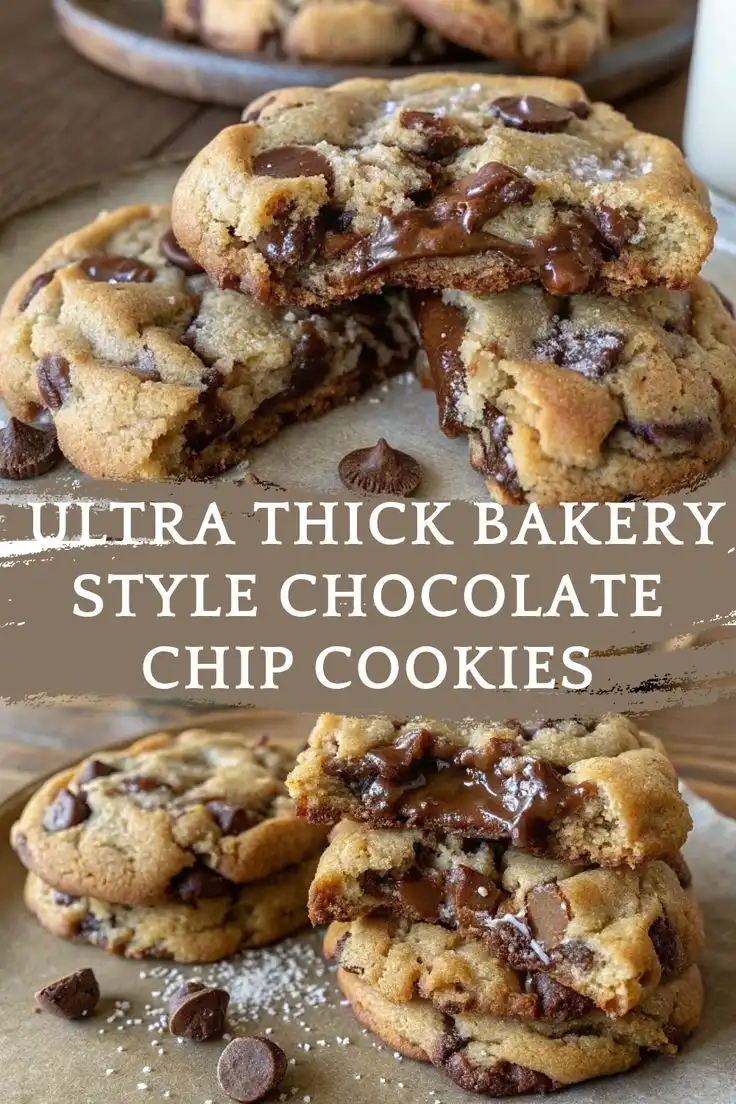
Welcome to the ultimate guide for crafting Ultra Thick Bakery Style Chocolate Chip Cookies — the kind that stop strangers in their tracks, fill your kitchen with the warm, buttery perfume of caramelized sugar and toasted vanilla, and deliver that iconic textural symphony: shatteringly crisp, golden-brown edges giving way to a luxuriously soft, molten, almost pudding-like center. These aren’t just cookies — they’re edible nostalgia, elevated. Inspired by the legendary $4.50 giants from artisanal bakeries in San Francisco, New York, and Chicago, this recipe meticulously replicates the structural integrity, visual grandeur (think 1.5-inch height and 4-inch diameter), and sensory contrast that defines true bakery excellence — all from your home oven. Whether you’re baking for a crowd, prepping for a bake sale, or treating yourself to a moment of unapologetic indulgence, these cookies promise restaurant-quality results with surprisingly accessible techniques.
The History
The evolution of the ultra-thick chocolate chip cookie is a delicious case study in culinary innovation meeting consumer desire. While Ruth Wakefield’s 1938 Toll House Cookie introduced the world to the concept, the “bakery style” iteration didn’t gain mainstream traction until the late 1990s and early 2000s, when gourmet bakeries like Levain Bakery in Manhattan began redefining expectations. Levain’s now-iconic 6-ounce cookie — baked on parchment-lined sheet pans, chilled for *at least* 24 hours, and pulled from the oven with gloriously underbaked centers — became an Instagram sensation long before social media existed, thanks to word-of-mouth lines stretching around city blocks. Chefs and food scientists soon dissected its success: a higher flour-to-sugar ratio for structure, melted *and* browned butter for depth, bread flour for gluten resilience, and extended chilling to prevent spread while hydrating the flour fully. This recipe honors that legacy — not as imitation, but as respectful, rigorously tested homage — incorporating decades of professional baking wisdom, including insights from Cook’s Illustrated’s exhaustive cookie trials, America’s Test Kitchen’s flour hydration studies, and interviews with pastry chefs who’ve scaled Levain-style production for national retail.
Ingredients Breakdown
Every ingredient here serves a precise functional role — no filler, no compromise:
- Unsalted Butter (1 cup / 227g, cubed & cold): Using cold, cubed butter (not melted) is non-negotiable for the signature flaky, layered edge texture. It creates steam pockets during baking, contributing to lift and crispness. We’ll melt *half* later for flavor, but the cold portion remains intact for structure.
- Browned Butter (½ cup / 113g, cooled to room temp): Browning ½ cup of the butter develops deep, nutty, toffee-like compounds (diacetyl, furans) that add unparalleled complexity and reduce perceived sweetness. Cooling it prevents cooking the eggs prematurely.
- Granulated Sugar (1 cup / 200g): Provides initial tenderness and promotes surface caramelization for crunch. Its lower moisture content vs. brown sugar slows spread.
- Packed Dark Brown Sugar (1 cup / 220g): Adds moisture, acidity (from molasses), and rich caramel notes. The acidity activates baking soda for optimal rise and chew. Dark, not light, for maximum flavor impact.
- Large Eggs (2, cold): Cold eggs help keep the dough temperature low during mixing, preserving butter integrity. They provide structure, emulsification, and moisture. One whole egg + one extra yolk adds richness and tenderness without excess water.
- Pure Vanilla Extract (2 tsp): Real Madagascar bourbon vanilla — not imitation — delivers floral, creamy top notes that balance the deep butter and caramel flavors.
- Baking Soda (1 tsp): The sole leavener. Reacts instantly with the acid in brown sugar for an early, powerful lift — crucial for achieving height before the edges set.
- Sea Salt Flakes (1 tsp fine + ½ tsp for finishing): Fine sea salt ensures even distribution for balanced flavor enhancement. A sprinkle of flaky Maldon or Jacobsen salt *after* baking amplifies the sweet-salt contrast on the crispy rim.
- All-Purpose Flour (2¼ cups / 281g, spooned & leveled): The base structure. Spooned and leveled prevents packing and over-flouring, which causes toughness.
- Bread Flour (¼ cup / 34g): The secret weapon for thickness. Higher protein (12–14%) forms stronger, more resilient gluten networks that trap steam and support the massive dough mound without collapsing. It’s what gives the center its dense, gooey, almost brioche-like crumb.
- High-Quality Semi-Sweet Chocolate Chips (2 cups / 340g): Use discs or chopped bars (60–65% cacao) — not standard chips. Standard chips contain stabilizers that resist melting; discs/chocolate create those coveted melty pools and marbled streaks. Guittard, Callebaut, or Scharffen Berger are ideal.
- Optional Add-In: Toasted Pecans or Walnuts (1 cup, finely chopped): Adds textural contrast and earthy richness. Toast first for maximum aroma.
Step-by-Step Recipe
- Brown the Butter: In a light-colored saucepan, melt ½ cup (113g) of the cold, cubed butter over medium heat. Swirl constantly. Once melted, continue cooking until foam subsides and butter turns golden amber with nutty brown specks (3–5 mins). Immediately pour into a heatproof bowl, scraping in all browned bits. Cool completely to room temperature (≈45 mins). Refrigerate if needed — it must be cool, not warm.
- Cream Cold Butter & Sugars: In a stand mixer fitted with the paddle attachment, beat the remaining ½ cup (113g) *cold, cubed* unsalted butter, granulated sugar, and packed dark brown sugar on medium speed for 3–4 minutes until very light, fluffy, and pale — almost like frosting. Scrape bowl thoroughly.
- Incorporate Wet Ingredients: Add the cooled browned butter, cold eggs (one at a time), and vanilla. Beat on medium-low for 30 seconds after each addition, just until combined. Do not overmix. Scrape bowl.
- Whisk Dry Ingredients: In a separate bowl, whisk together the all-purpose flour, bread flour, baking soda, and 1 tsp fine sea salt until fully homogenous. This ensures even leavening and salt distribution.
- Combine Dry & Wet: With mixer on low speed, gradually add the dry ingredients to the wet mixture in three additions, mixing only until *just* no dry streaks remain — ≈20 seconds per addition. Overmixing develops gluten excessively, leading to toughness. The dough will be thick, shaggy, and slightly sticky.
- Fold in Chocolate: Using a sturdy silicone spatula, gently fold in the chocolate chips (and nuts, if using) until evenly distributed. Some chips will break — that’s ideal for melty pockets!
- Chill, Chill, Chill (Non-Negotiable!): Cover the bowl tightly with plastic wrap, pressing it directly onto the dough surface to prevent drying. Refrigerate for a *minimum* of 24 hours, ideally 36–48 hours. This is critical: it solidifies the butter, hydrates the flour fully (reducing spread), concentrates flavors, and allows the baking soda to begin its slow reaction — all essential for thickness and chew. Do not skip or shorten this step.
- Preheat & Prep: At least 45 minutes before baking, place your oven rack in the center position and preheat to 375°F (190°C). Line two heavy-duty baking sheets (like AirBake or USA Pan) with parchment paper — do *not* use silicone mats; they insulate too much and inhibit bottom crispness.
- Scoop & Shape: Using a large #20 ice cream scoop (≈3 tablespoons / 50g per dough ball), portion chilled dough. Roll each portion firmly between your palms into a *tight, smooth sphere*. Place 3 inches apart on prepared sheets. Gently press the top of each ball with your palm to flatten *slightly* (≈¾ inch tall) — this encourages even spreading outward while retaining height. Sprinkle each cookie generously with flaky sea salt.
- Bake with Precision: Bake one sheet at a time in the preheated oven for 13–15 minutes. Rotate the sheet front-to-back at the 7-minute mark. Bake until edges are deeply golden brown and *set* (no jiggle when gently nudged), but centers look soft, puffed, and still appear slightly underbaked — they should have a delicate, moist sheen. The cookies will continue to cook on the hot sheet.
- Cool for Structural Integrity: Immediately upon removing from the oven, bang the hot baking sheet firmly on the counter *twice* — this collapses air pockets and sets the structure, preventing sinkage. Let cookies cool on the sheet for exactly 10 minutes. This allows the centers to set without over-baking. Then, carefully transfer to a wire rack to cool completely (≈30 mins). Patience is rewarded: cutting too soon releases steam and yields a gummy center.
Tips
- Butter Temperature is Everything: Cold butter = crisp edges. Warm butter = flat, greasy cookies. Keep butter cubes refrigerated until mixing. If your kitchen is >72°F (22°C), chill the mixing bowl and paddle for 15 minutes beforehand.
- Weigh Your Ingredients: Volume measurements for flour are notoriously inaccurate. A digital scale is the single best investment for consistent, ultra-thick results. 281g of AP flour is not the same as “2¼ cups.”
- Chill Time Cannot Be Rushed: 24 hours is the absolute minimum. 48 hours yields even better flavor development and chew. You can chill up to 72 hours. Freeze unbaked dough balls for up to 3 months — bake straight from frozen, adding 1–2 minutes to bake time.
- Don’t Skip the Sheet Bang: This professional trick creates the perfect “crust” on the bottom and locks in the airy, tender crumb. It’s science-backed — the shockwave redistributes heat and sets the gluten network instantly.
- Use Heavy-Duty Sheets: Thin, flimsy sheets warp and conduct heat unevenly, causing burnt bottoms and pale tops. Invest in commercial-grade aluminum sheets.
- Room Temperature Eggs Matter: Cold eggs help maintain overall dough temperature. But ensure your browned butter is *cool*, not warm, or it will cook the eggs and create scrambled bits.
- Measure Brown Sugar Correctly: Pack it firmly into the measuring cup with the back of a spoon — don’t just scoop and level. Under-packing leads to dry, cakey cookies.
- Rotate, Don’t Flip: Rotating the sheet ensures even oven exposure. Never flip cookies — their structure is too delicate mid-bake.
- Underbake Intentionally: Pull them out when centers look softly set but still glossy. They firm up dramatically during the 10-minute rest. Overbaking is the #1 cause of lost gooeyness.
- Store Properly: Keep cooled cookies in an airtight container at room temperature for up to 5 days. To revive freshness, warm individual cookies in a 350°F oven for 3–4 minutes.
Variations and Customizations
- Double Chocolate: Replace ¼ cup (30g) of the all-purpose flour with unsweetened cocoa powder (Dutch-process preferred). Add ½ cup (90g) mini chocolate chips for extra melty pockets.
- Snickerdoodle Swirl: After scooping, roll each dough ball in a mixture of 2 tbsp granulated sugar + 1 tsp ground cinnamon + ¼ tsp cream of tartar. Press down gently before baking.
- Peanut Butter Cup: Fold in 1 cup (170g) coarsely chopped peanut butter cups along with the chocolate chips. Reduce salt to ¾ tsp to balance sweetness.
- Oatmeal Chocolate Chunk: Substitute 1 cup (90g) of the all-purpose flour with old-fashioned rolled oats (not instant). Add ½ tsp ground cinnamon. Use chopped chocolate bars for rustic chunks.
- Espresso Infused: Dissolve 1 tbsp instant espresso powder in the cooled browned butter before adding to the creamed mixture. Enhances chocolate depth without adding bitterness.
- Gluten-Free Adaptation: Substitute AP and bread flour with a 1:1 certified GF blend containing xanthan gum (like King Arthur Measure for Measure or Bob’s Red Mill). Add 1 extra tbsp GF oat flour for binding. Chill 48 hours.
- Vegan Version: Use cold vegan butter (Miyoko’s or Country Crock Plant Butter), flax eggs (2 tbsp ground flax + 5 tbsp water, chilled), and dairy-free chocolate. Brown the vegan butter carefully — it burns faster.
- Mini Bakery Bites: Scoop with a #60 scoop (1 tbsp) and bake for 9–11 minutes. Perfect for parties or portion control — still ultra-thick relative to standard minis!
- Savory-Sweet Twist: Add 1 tsp flaky smoked sea salt and ½ tsp freshly cracked black pepper to the dry ingredients. Serve with a small scoop of bourbon vanilla ice cream.
- Stuffed Center: Flatten a dough ball, place 1/2 tsp dulce de leche or caramel sauce in the center, seal, and roll smooth. Creates a molten core revelation.
Health Considerations and Nutritional Value
While undeniably indulgent, understanding the nutritional profile empowers mindful enjoyment. Based on a standard yield of 16 cookies (using ingredients as listed):
- Per Cookie (approx. 113g): Calories: 385 | Total Fat: 21g (13g Saturated) | Cholesterol: 65mg | Sodium: 320mg | Total Carbohydrates: 46g (30g Sugars) | Protein: 5g | Fiber: 1g
- Key Considerations:
- Sugar Content: The high sugar is essential for texture and browning. For reduction, replace up to ¼ cup granulated sugar with monk fruit or erythritol blends — but expect less spread control and caramelization. Avoid liquid sweeteners (honey, maple syrup) as they increase spread and inhibit thickness.
- Fat Profile: Butter provides saturated fat, but also vital fat-soluble vitamins (A, D, E, K) and butyrate, linked to gut health. Using grass-fed butter increases omega-3s and CLA.
- Flour Choice: Bread flour’s higher protein supports satiety and blood sugar stability vs. pure AP flour. For increased fiber, substitute ¼ cup AP flour with white whole wheat flour — but increase chill time to 48 hours to manage hydration.
- Chocolate Benefits: High-cocoa chocolate (65%+) contributes flavonoids and antioxidants. Opt for ethically sourced, low-sugar varieties.
- Mindful Enjoyment: These cookies are designed as a special occasion treat, not daily fare. Pairing one cookie with a cup of unsweetened green tea or a small handful of almonds balances macros and enhances satisfaction. Portion control is built-in by the size — one is truly enough.
- Allergen Note: Contains dairy (butter), eggs, wheat (flour), and soy (in most chocolate). Always verify labels for hidden allergens.
- Not Suitable For: Strict keto, low-FODMAP (due to wheat and high-fructose corn syrup in some chocolates), or nut-free diets (unless omitting nuts and verifying chocolate).
Ingredients
- 1 cup (227g) unsalted butter, divided (½ cup cold & cubed, ½ cup for browning)
- 1 cup (200g) granulated sugar
- 1 cup (220g) packed dark brown sugar
- 2 large eggs, cold
- 2 teaspoons pure vanilla extract
- 1 teaspoon baking soda
- 1 teaspoon fine sea salt, plus extra for finishing
- 2¼ cups (281g) all-purpose flour, spooned & leveled
- ¼ cup (34g) bread flour
- 2 cups (340g) high-quality semi-sweet chocolate chips or chopped chocolate (60–65% cacao)
- (Optional) 1 cup (115g) toasted pecans or walnuts, finely chopped
Directions
- Heat ½ cup (113g) of the butter in a light-colored saucepan over medium heat. Swirl constantly until melted, then continue cooking until golden amber with nutty brown specks appear (3–5 minutes). Pour immediately into a heatproof bowl, scraping in all browned bits. Cool completely to room temperature (≈45 minutes). Refrigerate if needed — it must be cool, not warm.
- In the bowl of a stand mixer fitted with the paddle attachment, beat the remaining ½ cup (113g) cold, cubed butter, granulated sugar, and packed dark brown sugar on medium speed for 3–4 minutes until very light, fluffy, and pale. Scrape bowl thoroughly.
- Add the cooled browned butter, cold eggs (one at a time), and vanilla. Beat on medium-low for 30 seconds after each addition, just until combined. Scrape bowl.
- In a separate bowl, whisk together the all-purpose flour, bread flour, baking soda, and 1 tsp fine sea salt until fully homogenous.
- With mixer on low speed, gradually add the dry ingredients to the wet mixture in three additions, mixing only until *just* no dry streaks remain (≈20 seconds per addition). Do not overmix.
- Using a sturdy silicone spatula, gently fold in the chocolate chips (and nuts, if using) until evenly distributed.
- Cover the bowl tightly with plastic wrap, pressing it directly onto the dough surface. Refrigerate for a minimum of 24 hours, ideally 36–48 hours.
- Preheat oven to 375°F (190°C) with rack in center position. Line two heavy-duty baking sheets with parchment paper.
- Using a #20 ice cream scoop, portion chilled dough. Roll each portion firmly into a tight, smooth sphere. Place 3 inches apart on sheets. Gently press the top of each ball to flatten slightly (≈¾ inch tall). Sprinkle each generously with flaky sea salt.
- Bake one sheet at a time for 13–15 minutes, rotating sheet front-to-back at 7 minutes, until edges are deeply golden and set, but centers look soft, puffed, and slightly underbaked.
- Immediately upon removal from oven, bang the hot baking sheet firmly on the counter twice. Let cookies cool on sheet for exactly 10 minutes. Transfer to wire rack to cool completely (≈30 minutes).
FAQ
- Q: Why do I need both cold butter AND browned butter?
- A: Cold butter creates steam pockets for lift and crisp edges. Browned butter adds deep, complex flavor and moisture without promoting spread. Using only browned butter would make cookies greasy and flat; using only cold butter lacks that signature nutty depth.
- Q: Can I use all all-purpose flour instead of adding bread flour?
- A: Technically yes, but the cookies will spread significantly more and lack the dense, chewy, bakery-style center. Bread flour’s higher protein is essential for structural integrity at this thickness. Don’t skip it.
- Q: My cookies spread too much. What went wrong?
- A: Most common causes: 1) Butter was too warm during creaming, 2) Insufficient chilling time (<24 hours), 3) Oven temperature too low (use an oven thermometer!), 4) Using a silicone mat instead of parchment, 5) Overmixing the dough after adding flour.
- Q: Can I make the dough ahead and freeze it?
- A: Absolutely! Portion dough into balls, freeze on a tray until solid (2 hours), then transfer to a freezer bag. Bake straight from frozen — add 1–2 minutes to bake time and skip the pre-flattening step. They’ll still achieve incredible thickness.
- Q: Why do I need to bang the sheet after baking?
- A: The shockwave collapses unstable air pockets formed during baking, instantly setting the cookie’s structure. This prevents the center from sinking as it cools and locks in the tender, cohesive crumb — a pro technique used by Levain and similar bakeries.
- Q: Can I use milk chocolate or white chocolate chips?
- A: You can, but they won’t deliver the same balance. Milk chocolate is sweeter and softer, often making cookies cloying and less structurally stable. White chocolate lacks cocoa solids, so it melts into pools rather than distinct chips. Semi-sweet or dark is recommended for optimal flavor and texture contrast.
- Q: How do I get the perfect crispy edge every time?
- A: Crisp edges rely on: 1) Cold butter creamed properly, 2) Granulated sugar (for surface drying/caramelization), 3) Hot oven (375°F), 4) Baking on parchment-lined heavy sheets, 5) Not underbaking the edges — they must be deeply golden, not just light brown.
- Q: Are these cookies suitable for shipping?
- A: Yes! Their dense, thick structure makes them exceptionally sturdy. Cool completely, layer between parchment paper in an airtight tin, and ship via priority mail. They arrive tasting freshly baked.
- Q: Can I reduce the sugar without ruining the texture?
- A: Sugar is 50% of the cookie’s structure and spread control. Reducing by more than 2 tbsp total will result in drier, tougher, less spread-resistant cookies. For lower-sugar options, try our Double Chocolate variation with cocoa’s natural bitterness balancing sweetness.
- Q: What’s the best way to reheat a day-old cookie?
- A: Place on a parchment-lined baking sheet and warm in a 350°F oven for 3–4 minutes. This re-melts the chocolate and restores the crisp edge/soft center contrast far better than a microwave, which makes them soggy.
Summary
These Ultra Thick Bakery Style Chocolate Chip Cookies are a masterclass in precision baking: cold butter and browned butter unite for crisp edges and profound flavor, bread flour provides unwavering structural support for towering height, and a mandatory 24–48 hour chill develops flavor while ensuring minimal spread and maximum chew.
Every bite delivers the quintessential bakery experience — a shattering, caramelized perimeter yielding to a warm, dense, molten, almost fudgy center studded with rivers of premium chocolate — proving that extraordinary, restaurant-quality cookies are absolutely achievable at home with patience, quality ingredients, and science-backed technique.